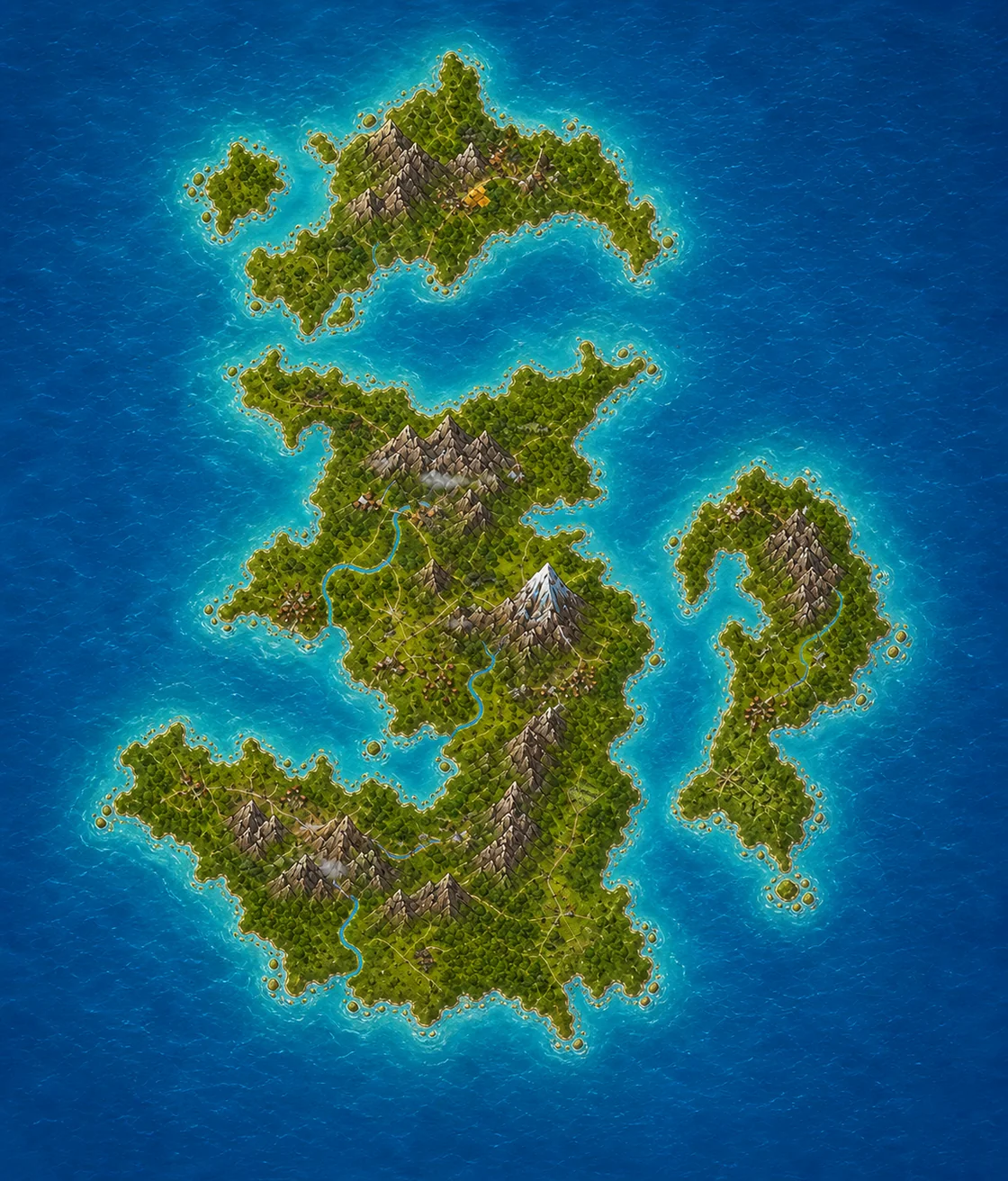
Three principal landmasses, forested mountains, volcanic ridges, sheltered river valleys, storm coasts and reef-filled shallows.
Country overview
About Tamakari
The Banner Isles
Mika and Hiro's island homeland is shaped by warrior houses, sea roads and mountain sanctuaries. Its culture draws on samurai-era Japan while remaining part of Sramad's own history and Essan traditions.
Country dossier
Power, knowledge and pressure
The landscape, rivalries and traditions shaping Tamakari.
An emperor rules with the Council of Banners. Great houses govern their own lands, while the First Sword arbitrates military duties and disputes between banners.
Armoured household warriors, disciplined spear formations, expert archers and fast coastal vessels. Rival houses make the realm formidable but politically brittle.
Moderate practical knowledge, with stronger scholarship around shrines, old blades, sealed caves and inherited relics. Learned families recognise that exceptional objects may hold Essan traces.
Myaks work through antiquities brokers, compromised retainers and false genealogies. Their strongest tactic is convincing ambitious houses that a discovered relic proves an ancient right to rule.
The sea protects Tamakari, but every harbour is also a border. Jade Sea lanes connect the islands to Vaar-Kashai and the eastern mainland.
Banner succession, harbour access and competing relic claims can turn one inheritance dispute into a national crisis.
History and societyHow Tamakari became itselfPeople, trade and the turning points that shaped the country.+
Tamakari balances inherited discipline with the uncomfortable knowledge that no tradition contains every truth. Service, restraint and household loyalty remain admired, but scholarship and foreign learning increasingly challenge the authority of old forms.
Warrior houses are culturally prominent without representing the whole population. Fishers, terrace farmers, shipwrights, lacquer workers, scribes, monks, physicians, divers, performers and rival schools of natural philosophy sustain the islands.
Rice terraces, fisheries, timber, lacquerware, fine steel, shipbuilding and Pearl Strait trade support the realm. Kaigen handles much of the foreign commerce, while Fujikawa controls court licences and the Relic Registers.
The Warring Shores
Island houses fought over harbour basins, timber slopes and fishing banks. Beacon alliances and marriage compacts gradually replaced permanent coastal war.
The Banner Settlement
The sovereign retained ritual law and land recognition while warrior houses kept provincial command. The office of First Sword was created to coordinate them in national emergencies.
The Opening of the Archives
Relic fragments and foreign discoveries have exposed gaps in inherited scholarship. The Genji mission west represents a wider argument over whether Tamakari should learn abroad or close itself against outside influence.
Institutions and peopleWho holds powerThe bodies and individuals through which authority is exercised.+
The Dawn Throne
Recognises land rights, calendars, diplomatic treaties and the legitimacy of the great houses.
Council of Banners
Brings provincial warrior houses into national taxation, law and defence while preserving substantial local rule.
Relic Registers
Records sealed caves, temple foundations, shipwrecks and dangerous objects whose original Essan functions are only partly understood.
Warrior-scholar and foreign envoy
Mika Genji
Mika carries the discipline of her homeland into a mission built on the admission that Tamakari needs knowledge from beyond its shores.
Warrior-scholar and Mika's brother
Horikamada Genji
Often called Hori, he shares responsibility for the Genji map fragments and the dangerous work of testing inherited knowledge against the wider world.
Head of the Genji family
Kentani Genji
Kentani's decision to send his children abroad places learning above safety and could either restore the family's influence or expose its oldest secret.