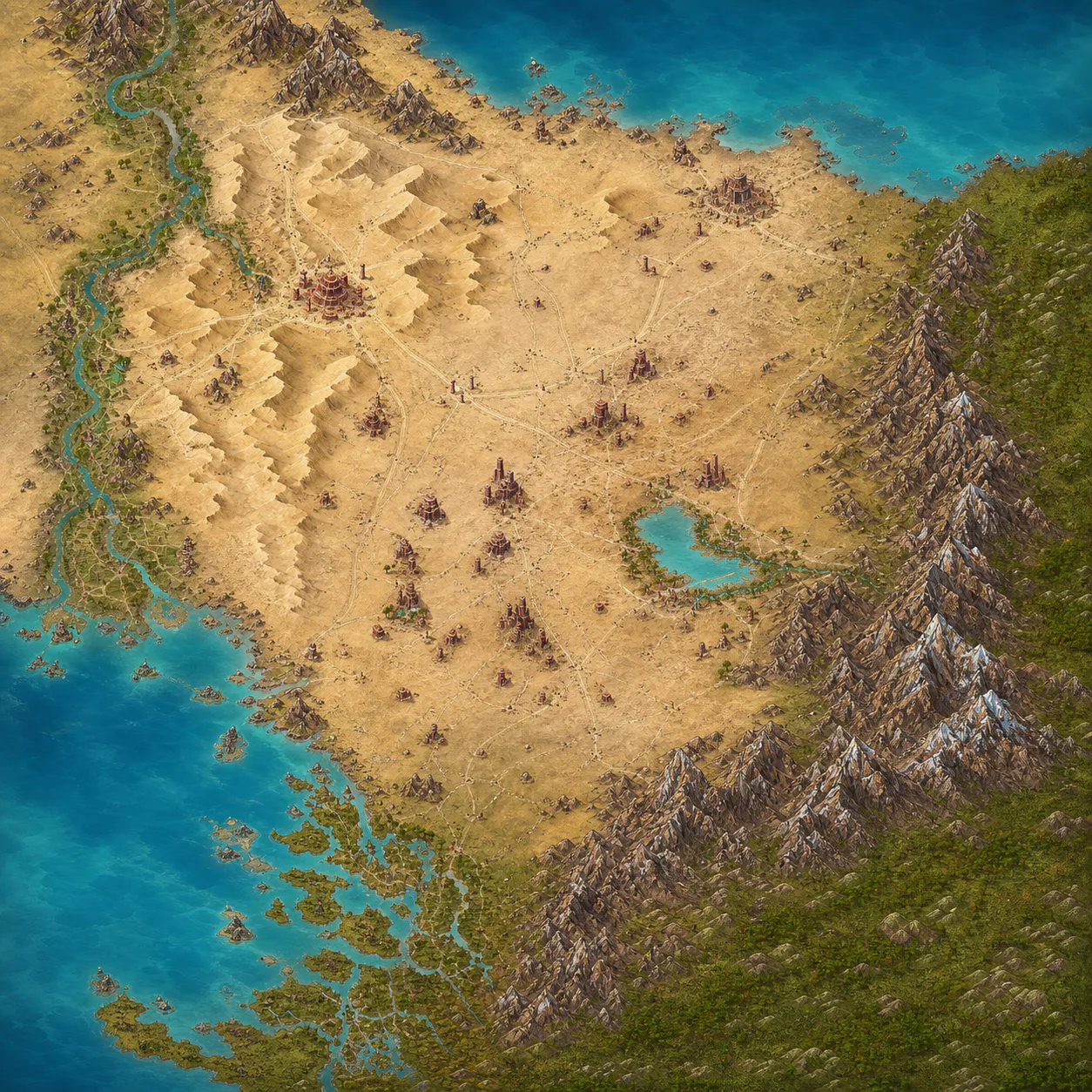
Dune seas, gravel plains, wadis, red stone formations, irrigated pockets, an eastern mountain wall and broken southern coast.
Country overview
About Zarran-Tal
The Measured Kingdom
A desert kingdom of surveyed land, caravan roads, red monuments and rare water. Its visual language draws on ancient Egyptian and wider North African inspiration without reproducing a single historical culture.
Country dossier
Power, knowledge and pressure
The landscape, rivalries and traditions shaping Zarran-Tal.
A Twin Crown divides sacred and civil authority. Provincial survey houses measure land, water allocations, taxes and caravan rights.
Disciplined spear infantry, desert scouts, chariot and mounted detachments, fortified wells and heavily protected caravan roads.
Strong scholarly knowledge survives in survey temples, tomb archives and relic catalogues. Public teaching is limited, but trained officials know magical artefacts exist.
Myaks exploit the gap between open scholarship and secret court collections. They pose as restorers, translators and survey specialists to reach sealed ruins.
Lignett controls the river approach to the north-west. The eastern mountains face Shal-Zura, while desert roads meet Atraquar and the southern sea lanes.
Water measurement, the ownership of newly uncovered ruins and access to Kharet-Alon's oasis produce constant tension between the Crown, survey houses and frontier communities.
History and societyHow Zarran-Tal became itselfPeople, trade and the turning points that shaped the country.+
Zarran-Tal measures scarcity. Water, shade, grain, distance and safe travelling hours are recorded because survival depends on knowing exactly what exists and who may use it.
River farmers, mobile pastoral communities, caravan families, masons, tomb custodians, surveyors, soldiers and scholars occupy very different landscapes. The state is respected for preserving order and feared for turning every person and resource into an entry in a ledger.
Grain, salt, copper, carved red stone, glass, linen, horses and caravan tolls support the Twin Crown. Archaeological licences and relic claims have become a second, increasingly corrupt economy.
Zarran and Tal
Desert route-keepers and irrigated river cities developed separate laws. Drought and repeated caravan wars eventually made control of water and roads impossible to divide.
The Double Investiture
One monarch was crowned separately as Keeper of Zarran and Voice of Tal. The House of Measures grew from the officials needed to reconcile both legal systems.
The Second Excavation
Newly exposed tombs and sealed chambers have enriched scholars and collectors. They have also given Myak agents a legitimate path into the country's oldest institutions.
Institutions and peopleWho holds powerThe bodies and individuals through which authority is exercised.+
The Twin Crown
Unites sacred desert authority and civil river authority in one ruler through two separate investitures.
House of Measures
Oversees surveys, canals, taxes, granaries, courts, labour records and caravan rights.
Tomb Houses
Maintain observatories, sealed archives and burial complexes, and compete over the ownership of old-age knowledge.
Bearer of the Twin Crown
Sahir Talun
A methodical ruler who believes accurate records prevent famine. His court is divided over whether relic research should remain public or become a royal monopoly.
First Measure
Namera Qael
The highest civil official in Khezran, responsible for reconciling water, tax and excavation claims that increasingly contradict one another.
Keeper of the Kharet-Alon tomb libraries
Setar Veyn
A respected scholar investigating references to the second breath. He does not know how many members of his own institution have already accepted Myak patronage.