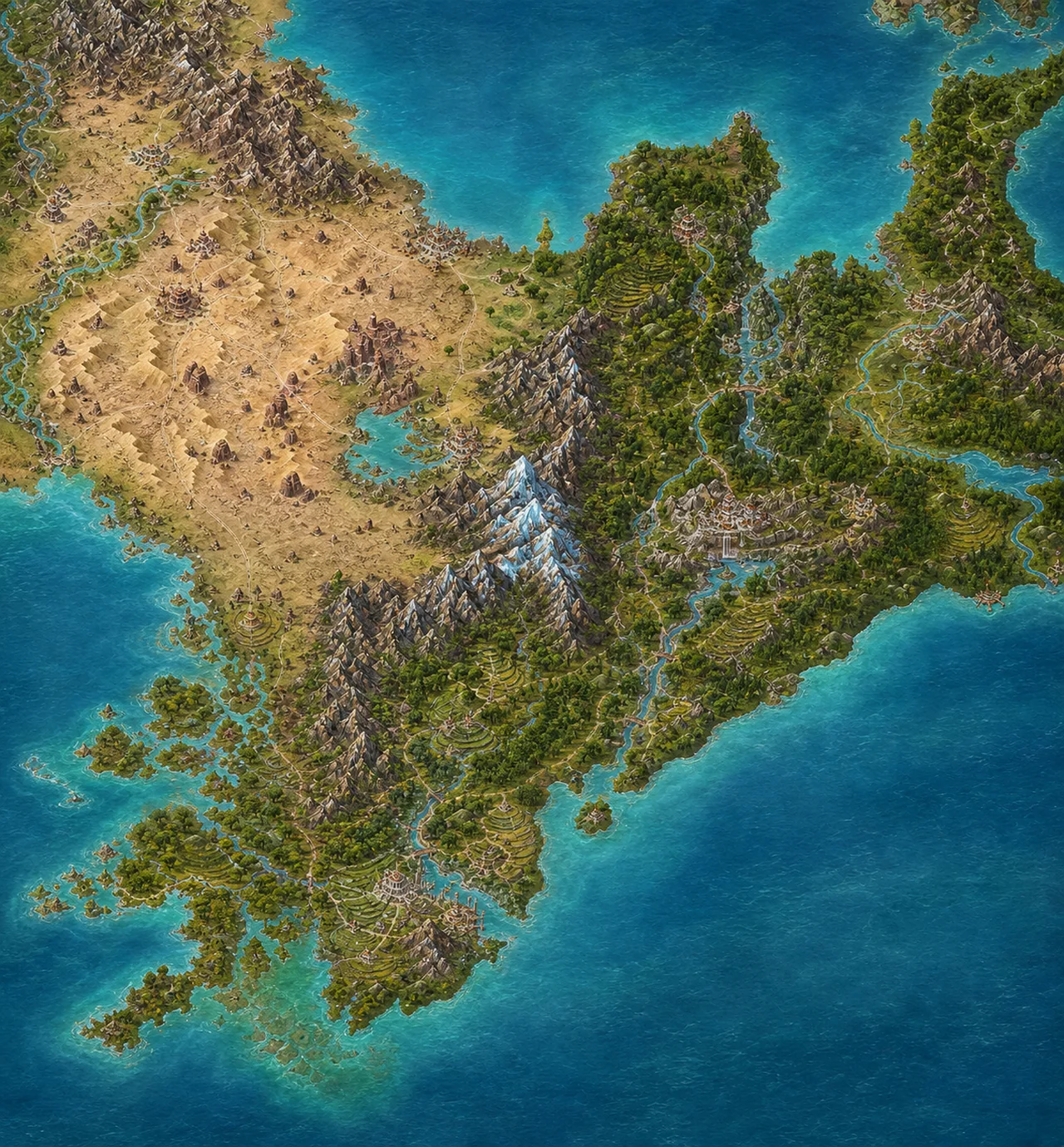
A diagonal mountain spine, glaciated summits, cloud forest, steep river valleys, mangrove channels and a humid southern coast.
Country overview
About Shal-Zura
The Mountain and Delta Realm
A long country of glaciated peaks, cloud forest, river valleys and southern deltas, caught between Zarran-Tal's desert edge and Vaar-Kashai's rainforest basins.
Country dossier
Power, knowledge and pressure
The landscape, rivalries and traditions shaping Shal-Zura.
Shal-Zura is governed through a compact between the lowland river councils and the highland courts. Major war, taxation of passes and access to relics require both seals.
Delta marines, light jungle infantry, highland shield troops and engineers trained to hold narrow routes.
Lowland traditions read tides and living channels. Highland custodians preserve mineral traditions around caves, ice and stone.
Myaks seek sealed mountain routes and encourage the belief that one half of the country is hiding power from the other.
The mountain wall divides Shal-Zura from Zarran-Tal, while northern river country meets Vaar-Kashai. Mangroves and broken coasts make the southern boundary difficult to patrol.
The largest pressure is whether highland and lowland law can remain joined when control of mountain relic sites and river tolls points in opposite directions.
History and societyHow Shal-Zura became itselfPeople, trade and the turning points that shaped the country.+
Shal-Zura is one country built from two older political traditions. Its hyphen remembers the Twin Compact between the delta realm and the mountain realm, whose food, metal, salt, water and military strengths remain inseparable.
Delta boat cities, wet-rice districts, trading guilds and flood engineers coexist with mountain clans, terrace farmers, pass wardens and stone-working communities. Most people accept the Compact while arguing intensely over what each half owes the other.
Zurim-Va exports rice, salt fish, dyes, timber and river craft. The highlands provide metal, stone, cold-water medicines and control of the passes. Ghadun and Thraxis profit from exchange, pilgrimage and disputed water rights.
The Two Realms
The delta courts governed tidal channels and maritime trade, while the highland crowns controlled terraces, springs and mountain passes. Each treated the other as necessary but untrustworthy.
The War of Broken Channels
A prolonged conflict damaged both irrigation and mountain roads. Food shortages in the heights and metal shortages in the delta forced the rulers into the Twin Compact.
The Strain of Two Seals
Joint government has prevented another war, but relic access, defence costs and the Ghadun-Thraxis water dispute now test whether the Compact can still act quickly enough.
Institutions and peopleWho holds powerThe bodies and individuals through which authority is exercised.+
The Twin Compact
Requires the Tide Speaker and Stone Crown to agree on war, borders and the opening of sealed Essan sites.
Compact Assembly
Represents delta districts, mountain clans, guilds and temple keepers, and controls common taxation.
The Two Archives
Keeps lowland tide-and-root records and highland stone-and-ice records in separate symbolic traditions that must be compared to understand the oldest sites.
Tide Speaker
Mara Selya
Mara rose through Zurim-Va's flood courts and argues that the delta cannot fund every mountain fortress while its own channels are failing.
Stone Crown
Othran Zur
A cautious highland ruler whose legitimacy depends on protecting sealed chambers and the passes. He fears that shared expeditions will become lowland seizures.
Keeper of the Two Seals
Ilyra Vesh
The senior neutral official of the Compact Assembly. Ilyra controls the documents that make joint decisions lawful and has become a target for agents trying to manufacture a constitutional crisis.