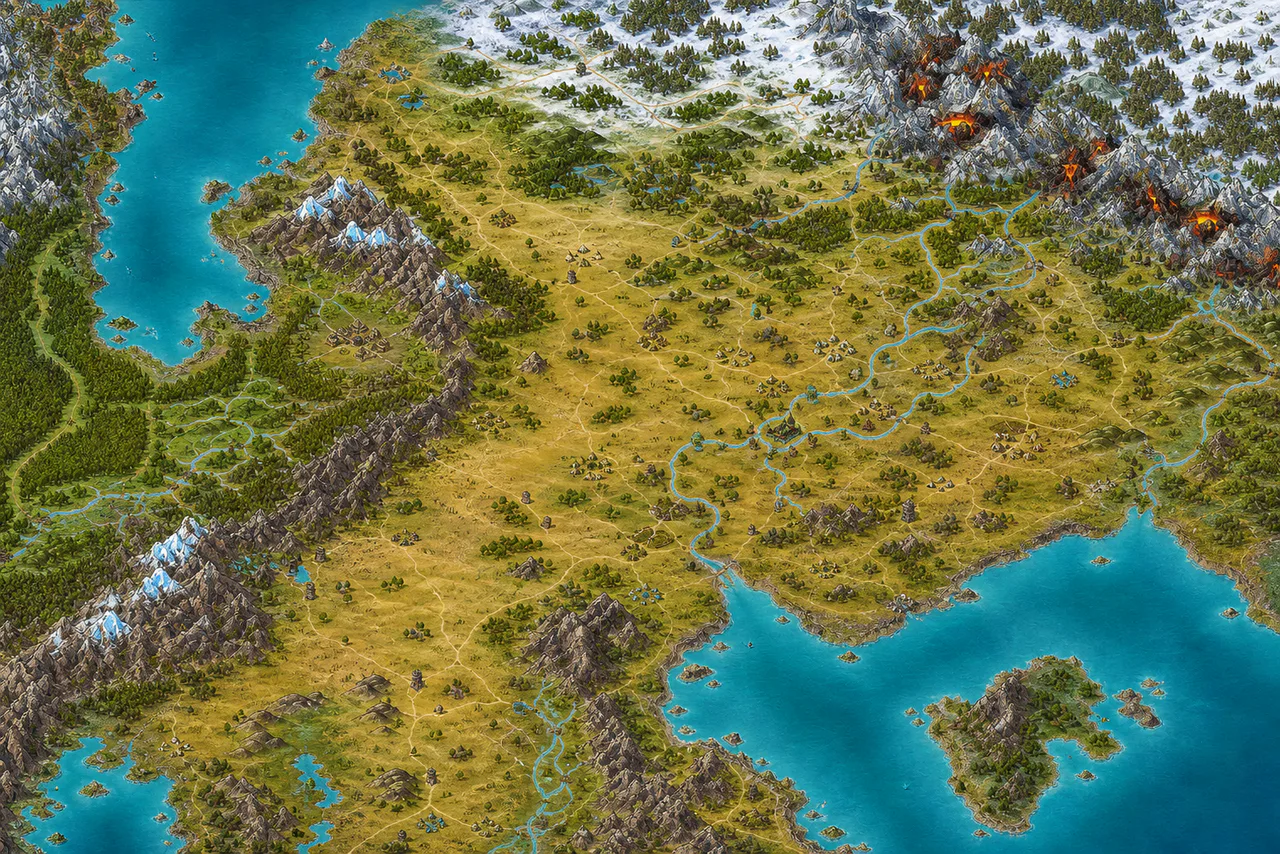
Long-grass steppe, birch and pine woodland, shallow lakes, broad rivers, cold northern ridges and mountain country in the west.
Country overview
About Snattack
The Seven Camps
A forest-steppe country whose communities move between long grass roads, river camps and sheltered winter grounds. Outsiders often mistake movement for disorder.
Country dossier
Power, knowledge and pressure
The landscape, rivalries and traditions shaping Snattack.
The Seven Camps Assembly selects a Road Speaker for diplomacy and a War Rider during major conflict. Authority follows reputation and consent rather than permanent court rank.
Mounted archers, scouts, mobile spear bands and wagon defences. Snattack forces are difficult to trap and excellent at denying supplies.
Knowledge is carried in songs, route stories and ancestor recitations. Skilled listeners recognise places where an old story changes because the land itself has changed.
Myaks imitate ancestors and manipulate oral testimony. A false memory placed in the right family can redirect an entire camp.
Vorkaroth lies beyond the eastern grazing country. The Thrall Mountains define the south-western edge, while the northern frontier remains cold and sparsely settled.
Grazing and winter rights overlap with Vorkaroth claims. The larger internal question is whether permanent settlements should receive authority equal to the moving camps.
History and societyHow Snattack became itselfPeople, trade and the turning points that shaped the country.+
Snattack understands borders as agreements over roads, wells, pasture and seasons. Mobile camps and settled towns share a nation while disagreeing over how fixed its laws should become.
Herders, grain farmers, fishers, caravan families, singers and town craftspeople gather through camp coalitions rather than one bloodline. Oral law and route memory carry authority equal to written charters.
Horses, wool, leather, grain, lake fish, caravan escort and seasonal markets sustain the country. Its open roads are valuable precisely because neighbouring powers want to tax or fortify them.
The Seven Roads
Different camp coalitions followed recurring pasture and river routes, meeting at neutral burial grounds to settle disputes.
The Treaty of Seven Camps
Towns and mobile camps separated diplomatic and military offices so no successful war leader could automatically become ruler.
The Closing Roads
Kalton forts, Vorkaroth claims and proposed fixed tolls threaten seasonal movement. Town leaders increasingly favour borders that many camps consider a form of confinement.
Institutions and peopleWho holds powerThe bodies and individuals through which authority is exercised.+
Seven Camps Assembly
Meets twice yearly and in emergencies, with each camp representing a coalition of towns and clans.
Road Speaker
Handles diplomacy, trade agreements and safe passage but has no automatic command over the army.
War Rider
Coordinates national defence while remaining legally separate from the diplomatic office.
Road Speaker
Asha Keren
A patient negotiator trying to preserve open corridors without giving neighbouring states an excuse to occupy them.
War Rider
Temur Sai
A celebrated mounted commander who believes permanent border posts are now unavoidable, placing him at odds with several camp coalitions.
Route singer
Elka Nhar
Elka can hear changes in sound around buried old-age objects. Scholars dismiss her method, while Myak agents have begun searching for the same burial songs.